
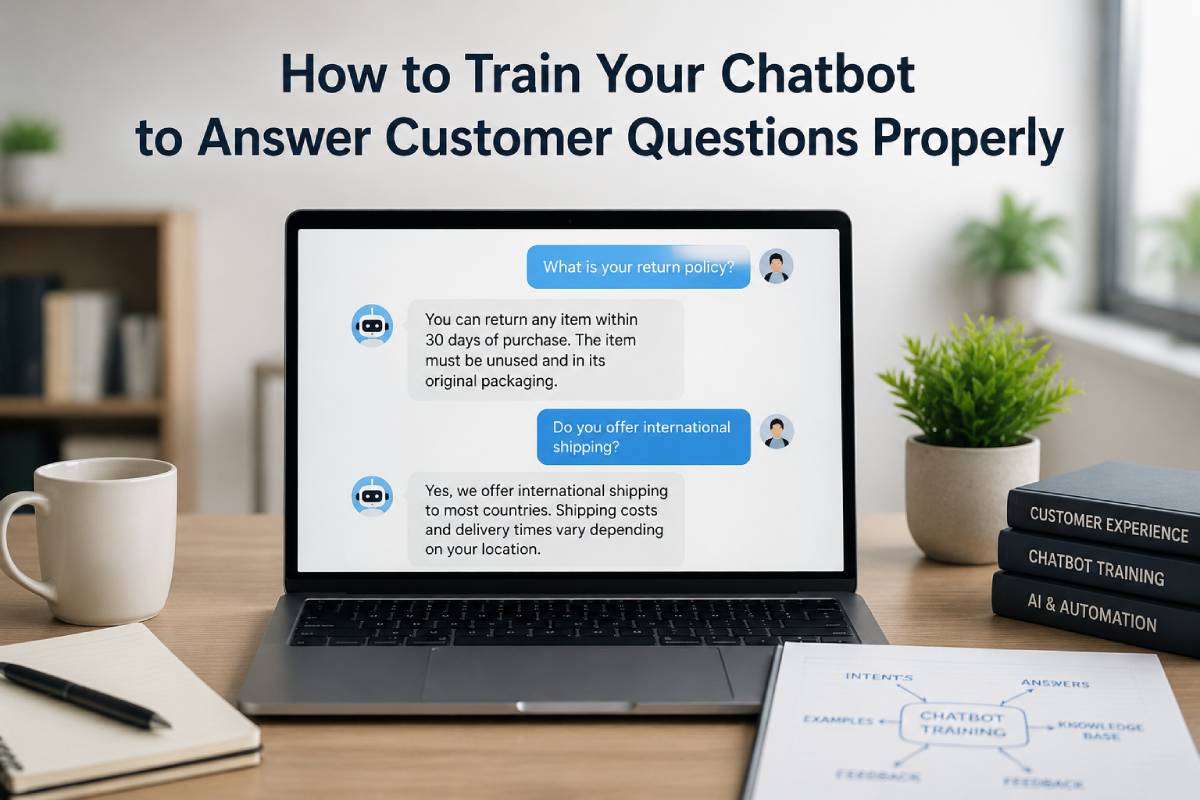
How to Train Your Chatbot to Answer Customer Questions Properly
Imagine this:
A potential customer lands on your website.
They're interested in your service and ready to ask a question.
"Do you offer emergency service?"
"How much does it cost?"
"Can I book online?"
"Do you serve my area?"
Instead of getting a helpful answer, your chatbot responds with:
"Please contact us for more information."
The customer leaves.
They visit a competitor's website.
Within minutes, you've lost a lead without ever knowing it happened.
This scenario plays out every day for businesses that install a chatbot but never properly train it.
A chatbot should do more than respond to messages. It should answer customer questions accurately, guide visitors toward the next step, reduce repetitive support requests, and help convert website traffic into leads.
The difference between a chatbot that helps your business grow and one that frustrates customers usually comes down to one thing: training.
Table of Contents
Quick Answer
To train your chatbot properly, you need to provide accurate information about your business, services, locations, policies, and frequently asked customer questions. You should train it using real customer conversations, create a reliable knowledge base, define when the chatbot should transfer users to a human, and continuously improve it based on customer interactions.
When done correctly, a chatbot becomes a valuable customer service and lead generation tool rather than a source of frustration.
Why Most Business Chatbots Fail
Many business owners believe chatbots fail because the technology isn't good enough.
In reality, most chatbots fail because they were never given the information needed to succeed.
A chatbot can only answer questions using the knowledge it has access to.
If that information is incomplete, outdated, generic, or poorly organized, the chatbot will struggle.
Common signs of a poorly trained chatbot include:
-
Giving vague answers
-
Repeating the same responses
-
Misunderstanding customer intent
-
Providing incorrect information
-
Failing to collect leads
-
Sending customers in circles
-
Ignoring location-specific questions
-
Not knowing when to transfer to a human
Customers rarely blame the technology.
They blame the business.
That means a bad chatbot can damage trust just as quickly as a poorly trained employee.
Why Accurate Chatbot Answers Matter More Than Ever
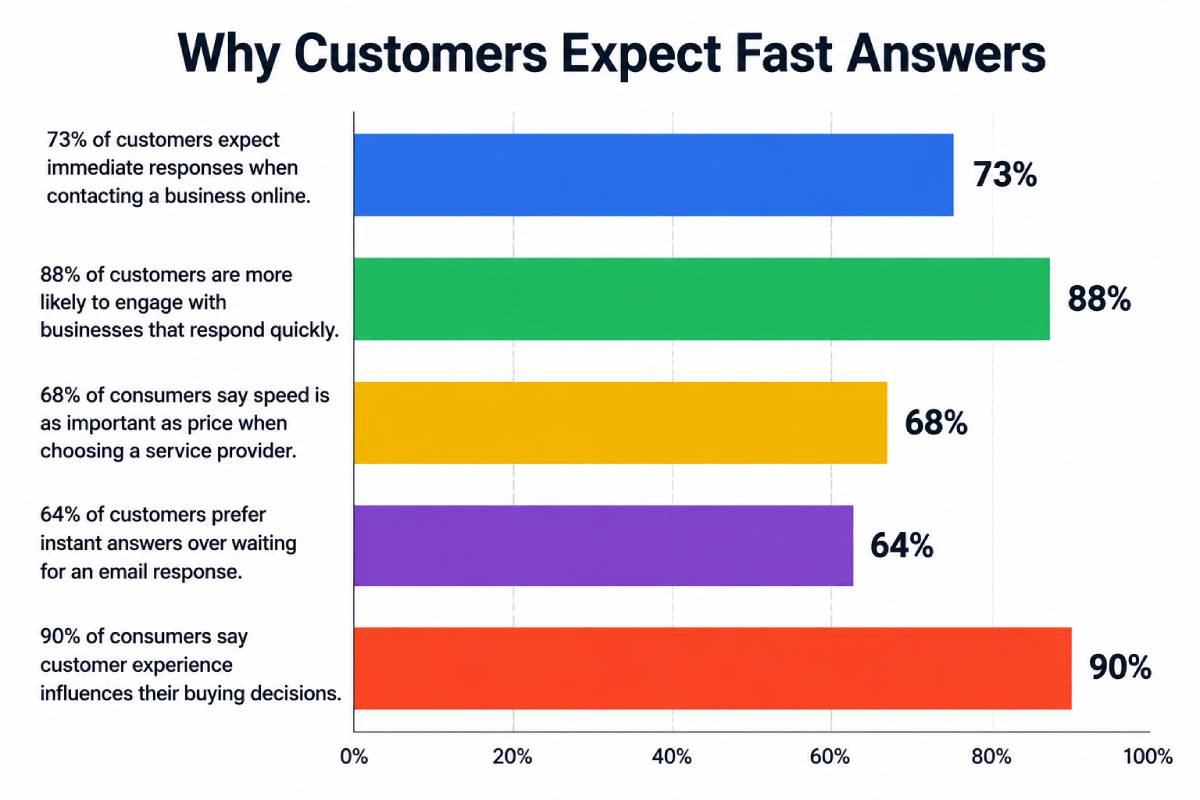
Customer expectations have changed.
People expect answers immediately.
They don't want to wait hours for an email reply or spend time searching through multiple pages on your website.
Whether you operate a restaurant, medical clinic, contractor business, retail store, law firm, or service company, customers expect quick and accurate information.
They want answers to questions such as:
-
Do you serve my area?
-
How much does the service cost?
-
How soon can I book?
-
What are your hours?
-
What service is right for me?
-
Do you offer emergency appointments?
-
Can I get a quote online?
The faster customers receive useful answers, the more likely they are to stay on your website and move forward.
This is why learning how to train a chatbot for customer service has become such an important topic for modern businesses.
Start With Real Customer Questions
One of the biggest chatbot training mistakes is relying only on FAQs.
Instead, start with real customer conversations.
Look at:
-
Phone call logs
-
Contact forms
-
Live chat transcripts
-
Email inquiries
-
Google Business Profile questions
-
Social media messages
-
Reception desk questions
-
Sales team notes
These conversations reveal exactly what customers care about.
For example, a dental clinic may receive questions such as:
-
Do you accept new patients?
-
Do you offer evening appointments?
-
Do you direct bill insurance?
A restaurant may hear:
-
Do you offer vegetarian options?
-
Do you take reservations?
-
Is your food halal?
-
Do you deliver near me?
A contractor may frequently answer:
-
Do you provide free estimates?
-
How soon can you start?
-
Do you serve Vaughan or Markham?
These are not random questions.
They are buying signals.
Training your chatbot using real customer questions allows it to answer naturally and provide the information customers need to make decisions.
Build a Strong Knowledge Base
A chatbot is only as good as the information behind it.
That's why chatbot knowledge base training is one of the most important parts of the process.
Your knowledge base should include:
Service Information
Provide clear descriptions of every service you offer.
Avoid vague explanations.
The chatbot should understand what each service does, who it's for, and how customers can get started.
Service Areas
Many local businesses forget this step.
If you serve Toronto, North York, Vaughan, Markham, Richmond Hill, Mississauga, Scarborough, or the GTA, your chatbot should know exactly where you operate.
Location-based questions are among the most common customer inquiries.
Business Hours
Customers frequently ask:
"Are you open today?"
"What time do you close?"
"Do you have weekend appointments?"
Accurate hours prevent frustration and improve customer satisfaction.
Pricing Guidance
While some businesses cannot provide exact pricing online, customers still appreciate estimates, ranges, or explanations of how pricing works.
Policies and Procedures
Include information about:
-
Booking policies
-
Cancellation policies
-
Delivery policies
-
Consultation procedures
-
Payment options
When your chatbot has access to this information, answers become more accurate and useful.
Want a chatbot that actually understands your customers and answers correctly every time?
We can help you design and train a chatbot that improves customer experience and generates real leads for your business.
Train Your Chatbot on Services, Not Just FAQs
Many businesses use generic chatbot templates.
As a result, their chatbot sounds robotic and unhelpful.
A roofing company's chatbot should not answer questions the same way as a cosmetic clinic chatbot.
A restaurant chatbot should not sound like an e-commerce store.
Your chatbot needs industry-specific knowledge.
For example, a medical aesthetics chatbot should understand:
-
Consultation procedures
-
Treatment options
-
Appointment requirements
-
Recovery expectations
-
General pricing information
A contractor chatbot should understand:
-
Project types
-
Service areas
-
Timeline expectations
-
Quote requests
-
Emergency services
The more specific your training becomes, the more valuable your chatbot becomes.
The Most Common Chatbot Training Mistakes
Using Generic Answers
Customers dislike vague responses.
Instead of saying:
"We offer many services."
A better answer would be:
"We offer website design, SEO, Google Ads management, chatbot development, and digital marketing services for businesses throughout Toronto and the GTA."
Specific answers build trust.
Letting the Chatbot Guess
A chatbot should never invent information.
If it doesn't know the answer, it should say so.
Guessing creates confusion and can damage credibility.
Ignoring Location Questions
Local businesses receive location-based inquiries every day.
Your chatbot should understand neighborhoods, cities, and service areas.
Failing to Update Information
Businesses change.
Services change.
Pricing changes.
Hours change.
Your chatbot should evolve alongside your business.
Being Too Aggressive with Lead Capture
Customers want help first.
If the chatbot immediately asks for contact information without providing value, visitors often leave.
Teach the Chatbot When to Hand Off to a Human
One of the smartest things a chatbot can learn is when not to answer.
Certain situations require human support.
Examples include:
-
Medical advice
-
Legal advice
-
Custom pricing requests
-
Complex technical issues
-
Complaint resolution
-
Sensitive customer concerns
-
Emergency situations
A properly trained chatbot should recognize these situations and smoothly transfer the conversation.
Customers appreciate honesty far more than incorrect answers.
How to Improve Chatbot Accuracy Over Time
Chatbot training isn't a one-time task.
The most successful businesses continually optimize their chatbot.
Review conversations regularly and ask:
-
Which questions were answered poorly?
-
Which questions were not understood?
-
Where did customers leave the conversation?
-
What new questions are appearing?
-
Which answers generate leads?
Over time, these improvements dramatically increase chatbot performance.
Think of chatbot optimization the same way you think about SEO.
The businesses that continuously improve achieve the best results.
How a Well-Trained Chatbot Helps Generate More Leads
A properly trained chatbot doesn't just answer questions.
It helps move customers toward action.
After providing useful information, it can naturally ask:
-
Would you like a quote?
-
Would you like to schedule a consultation?
-
Would you like someone from our team to call you?
-
Would you like to book an appointment?
This approach feels helpful rather than pushy.
The chatbot can then collect:
-
Name
-
Phone number
-
Email address
-
Service needed
-
Location
-
Preferred contact time
This information can automatically be sent to your sales team or CRM for follow-up.
For many businesses, this is where chatbot lead generation becomes extremely valuable.

Why Chatbot Training Supports SEO and AI Search Visibility
Many business owners don't realize that chatbot training can also support SEO.
To train a chatbot properly, you must organize your business information clearly.
That same information strengthens:
-
Service pages
-
FAQ pages
-
Local SEO
-
Knowledge bases
-
Voice search visibility
-
AI search visibility
-
Customer experience
Today's customers increasingly search using conversational phrases such as:
-
How do I train a chatbot to answer customer questions?
-
What information should a business chatbot know?
-
How can a chatbot generate leads?
-
How do I improve chatbot accuracy?
-
What is the best chatbot for a small business website?
When your content and chatbot are aligned, both customers and search engines gain a clearer understanding of your business.
-
Missed Calls = Missed Money: How AI Chatbots Turn Every Visitor into a Lead
-
Why Integrating Chatbots with Your CRM Can Transform Sales and Marketing
-
How to Add a Chatbot to Your Restaurant Website, Instagram, and Google-Step-by-Step
-
We Gave Chatbots to 3 Toronto Businesses Here’s What Actually Happened
What a Properly Trained Chatbot Can Do
A well-trained chatbot can:
-
Answer customer questions instantly
-
Reduce repetitive support requests
-
Improve customer satisfaction
-
Capture qualified leads
-
Support customers after business hours
-
Increase website engagement
-
Improve conversion rates
-
Help visitors find the right service faster
-
Support customer service teams
-
Strengthen the overall customer experience
Most importantly, it helps customers get the information they need without friction.
And that's exactly what modern consumers expect.

Ready to turn your website into a lead-generating machine with a properly trained AI chatbot?
At Unlimited Exposure Online, we help businesses build intelligent chatbots that answer customer questions accurately, guide users effectively, and convert traffic into real bookings and sales.
Build and Train a Business Chatbot in Less Than 60 Seconds
Reading about chatbot training, knowledge bases, prompts, customer intents, and optimization can feel overwhelming for many business owners. While manually training a chatbot can produce excellent results, the reality is that most small businesses simply do not have the time, technical expertise, or resources to build everything from scratch.
Fortunately, newer AI chatbot platforms have made the process dramatically easier.
For example, with platforms like AI Agent Factory, you do not need to spend days creating training documents, writing complex prompts, or manually feeding information into an AI model. In many cases, all you need to do is enter your website domain, and the platform automatically scans your website, analyzes your pages, identifies your services, and creates a fully functional AI chatbot in less than 60 seconds.
The system can automatically generate a custom knowledge base, build the initial system prompt, organize your business information, and train the chatbot using the content already available on your website. Instead of starting with a blank screen, business owners can launch a chatbot that already understands their services, locations, FAQs, and customer-facing content.
This can be especially valuable for local businesses, restaurants, clinics, contractors, and service providers that want to offer instant customer support without spending weeks learning how chatbot training works.
Rather than worrying about prompt engineering, AI workflows, training datasets, or chatbot configuration, business owners can focus on running their business while the platform handles much of the technical setup behind the scenes.
For companies looking for the fastest path to deploying an AI chatbot, automated chatbot training platforms such as AI Agent Factory can significantly reduce the learning curve and make advanced AI technology accessible to businesses of any size.
Frequently Asked Questions
How do I train a chatbot to answer customer questions properly?
Start by collecting real customer questions from calls, emails, forms, and chats. Build a detailed knowledge base that includes your services, service areas, policies, pricing information, and booking procedures. Then continuously test and improve responses using real customer interactions.
Why does my chatbot give wrong answers?
Most chatbots provide inaccurate answers because they lack reliable information, use outdated content, or have not been properly trained. Improving the quality of your knowledge base is often the fastest way to improve chatbot accuracy.
Can a chatbot help generate leads?
Yes. A properly trained lead generation chatbot can answer questions, qualify prospects, collect contact information, and connect visitors with your sales team at the right moment.
How often should chatbot training be updated?
Review chatbot conversations monthly and update information whenever your services, pricing, policies, or business details change. Ongoing optimization produces significantly better results over time.
Is chatbot training important for small businesses?
Absolutely. Small businesses often receive the same questions repeatedly. A well-trained chatbot can reduce repetitive inquiries, support customers after hours, and help capture more leads without increasing staff workload.
Final Thoughts
Installing a chatbot is easy.
Training it properly is where the real value comes from.
Customers don't care how advanced your chatbot technology is. They care whether it can answer their questions accurately and help them move forward.
When you train your chatbot using real customer questions, build a reliable knowledge base, define clear boundaries, and continually optimize its performance, it becomes much more than a website feature.
It becomes a powerful customer service tool, a lead generation asset, and an extension of your business.
The businesses that invest in proper chatbot training today will be the ones delivering better customer experiences, generating more leads, and staying ahead as AI-powered customer interactions continue to grow.
About Unlimited Exposure Online
Unlimited Exposure Online is a Toronto-based digital marketing and web development agency specializing in helping local businesses and service-based companies turn website visitors into real customers through AI-powered systems and conversion-focused strategies.
We help businesses improve how they communicate with customers online through services such as AI chatbot development, chatbot training and optimization, local SEO, Google Business Profile management, Google Maps ranking, website conversion optimization, and digital marketing automation.
If your business is getting website traffic but your chatbot is confusing visitors, missing leads, or failing to answer customer questions properly, we can help.
We focus on building smart digital systems that improve customer experience, increase engagement, and turn online searches into calls, bookings, and real sales.
Ready to improve your chatbot and turn more visitors into customers?
Contact Unlimited Exposure Online today and let’s grow your business together.
