

The AI Temptation: Should You Fire Your Web Dev in 2026?
Let’s be honest if AI can build a website in five minutes, why are businesses still paying developers thousands of dollars?
Technology moves at a dizzying pace, and it seems like every few weeks there’s a new tool promising to save time, reduce costs, and eliminate complexity. Right now, the loudest noise surrounds Artificial Intelligence building websites. You’ve likely seen the claims:
• “Generate your entire website in minutes.”
• “Replace your expensive developer with AI.”
It’s an appealing idea. Faster builds, lower costs, fewer dependencies, what's not to like?
But before making drastic decisions, it’s worth pausing for a moment. Is AI genuinely ready to replace human developers, or is this simply another wave of technological optimism that could create unexpected business risks?
Table of Contents
Takeaways
The Hybrid Approach to Web Development in 2026:
In 2026, AI offers unprecedented speed and cost efficiency for basic web development. However, for average business owners, a purely AI-driven website often becomes a "business trap" lacking strategic depth, advanced integrations, and crucial Answer Engine Optimization (AEO).
While AI excels at generating functional code and designs, human web developers remain essential for custom strategy, complex integrations, emotional brand storytelling, and ensuring high search visibility on platforms like ChatGPT and Claude.
The most effective approach for businesses is a hybrid model, where developers leverage AI tools to enhance productivity and deliver superior, strategically aligned websites, rather than being replaced by them.
Businesses should evaluate their specific needs for conversion, integration, and unique brand presence before deciding to move from human-led development.
The "5-Minute Website" Promise: What AI Can (Really) Do
Let’s give credit where credit is due: AI has made incredible strides. Tools like Wix ADI, Durable, or even more advanced AI design agents can now whip up a functional website faster than you can brew a cup of coffee.
-
Speed: This is AI’s superpower. Describe your business, answer a few questions, and poof – you have pages, images, and even some placeholder text. What used to take days or weeks of initial setup can now literally happen in minutes.
-
Cost: Many AI website builders come with a much lower monthly subscription fee than hiring a dedicated developer or agency. If budget is your absolute top concern, AI presents a very attractive upfront cost.
-
Basic Functionality: Need a simple "digital business card" site with an About Us, Services, and Contact page? AI can handle the basics surprisingly well, laying out content, choosing color schemes, and even suggesting stock images. It’s perfect for getting something online quickly.
On the surface, it sounds like a dream come true, right? But as with most things that sound too good to be true, there’s a catch.
The Hidden Traps: Where AI-Only Development Falls Short
While AI is fantastic for the foundational build, relying solely on it for your business's online presence can lead to significant headaches down the road. These aren't always obvious until you've committed, and by then, correcting course can be more expensive than just doing it right the first time.
-
Lack of Strategic Depth & Business Acumen: AI doesn’t understand your business. It doesn’t know your unique selling proposition, your target audience's deepest pain points, or the specific psychological triggers that make them convert from a visitor into a customer. AI builds a website; a human developer, especially a good one, builds a business asset. They think about conversion funnels, user journeys, and how each page drives you towards your specific business goals, not just aesthetic appeal. AI-generated content often feels generic, missing the specific nuances that resonate with your customers.
-
Integration Headaches & Data Flow: Your website isn't an island. It needs to "talk" to your CRM (customer relationship management) system, your email marketing platform, your booking software, your inventory system, and more. While some AI tools offer basic integrations, complex, secure, and seamless data flow between different platforms is still very much a human developer's domain. When these integrations break (and they often do with purely AI-driven setups), troubleshooting can be a nightmare, leaving you with disconnected systems and lost business.
-
The "Generic" Look: Standing Out in an AI-Generated World: If everyone is using the same AI tools, what happens? All the websites start to look… well, similar. AI learns from existing patterns. It’s great at remixing, but not so great at true, groundbreaking originality. If your goal is to stand out from your competitors, create a memorable brand identity, and convey a unique story, relying solely on AI might leave you with a perfectly functional, yet utterly forgettable, website.
Why Human Developers Are More Important Than Ever (Just Different)
This isn't to say your web developer's job hasn't changed. It has! But in 2026, a smart human developer isn't competing against AI; they're leveraging it to be faster, more efficient, and to deliver even more strategic value to you.
-
The Rise of the "AI-Enhanced" Developer: Think of AI as an incredibly powerful assistant. Your developer can use AI to automate repetitive coding tasks, generate initial design concepts, or even help debug. This frees them up to focus on the higher-level, strategic work that truly impacts your bottom line. They become less of a "coder" and more of a "digital architect" – designing intelligent systems with AI's help.
-
Beyond SEO: Mastering Answer Engine Optimization (AEO): You've heard of Local SEO or plain SEO (Search Engine Optimization), right? Getting your website to rank high on Google. Well, in 2026, the game has evolved. With the rise of AI assistants like ChatGPT, Claude, and Google's SGE (Search Generative Experience), people aren't just clicking links; they're asking questions and getting direct answers. This means your website needs to be optimized for Answer Engine Optimization (AEO). This involves incredibly precise Schema Markup and structured data that tells AI exactly what your content is about, making it easier for them to pull your information into their direct answers. This is a complex, nuanced field where human expertise is currently indispensable. AI often struggles to implement this advanced metadata correctly, which means your perfectly good website might be invisible to the very AI systems people are now using to find information.
-
The Human Touch: Emotion, Storytelling, and Brand Soul: AI can write copy, but can it truly capture the soul of your brand? Can it tell a story that evokes emotion and builds genuine connection with your audience? Can it intuit the subtle design choices that create an unforgettable user experience? Not yet. A skilled human developer and designer understands the psychology of your users, crafting an experience that resonates, builds trust, and ultimately converts. They bring creativity, empathy, and strategic thinking that algorithms simply can’t replicate.

When to Go AI-Only (and When Not To)
So, how do you decide?
-
Go AI-Only If:
-
You need a very basic, temporary landing page for a specific campaign or event.
-
You're launching a brand-new concept and need an MVP (Minimum Viable Product) website to test the waters quickly and cheaply.
-
Your budget is extremely limited (under $50/month) and your business's online presence isn't critical for conversions yet.
-
You have a simple brochure site that rarely changes and doesn't require any integrations.
-
Keep Your Developer (or hire an AI-enhanced one) If:
-
Your website is a core part of your sales or lead generation funnel.
-
You need custom functionality, complex integrations, or advanced e-commerce features.
-
Standing out from competitors with a unique brand and user experience is crucial.
-
You care about being found through Answer Engine Optimization (AEO) on AI platforms like ChatGPT and Google's SGE.
-
You want security, ongoing maintenance, and expert support to troubleshoot issues.
-
You need a website that grows and evolves with your business strategy.
If you’re running a business in Toronto or the GTA and wondering whether AI tools can really replace your developer, this is a conversation worth having. Every business has different integration, visibility, and conversion needs. Before making costly changes, speak with a local team that understands both AI systems and real-world business websites.
Making the Smart Decision: A Checklist for Business Owners
Before you make any big moves, ask yourself:
-
What's the primary purpose of my website? (Informational, lead generation, e-commerce, community building?)
-
How critical is my website to my revenue or business goals?
-
Do I need to integrate with other business tools (CRM, booking, etc.)?
-
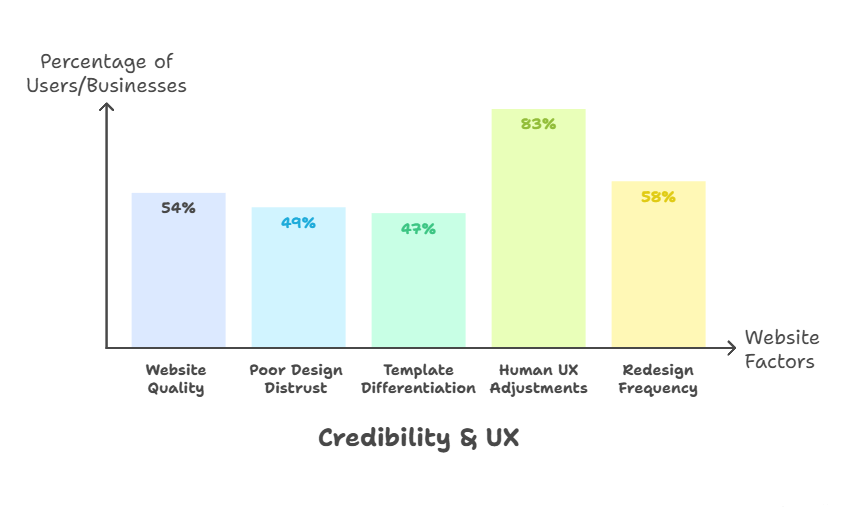
Do I want to stand out, or am I okay with a generic template?
-
How important is being found via AI search engines (AEO)?
-
Does my current developer embrace AI to be more efficient, or are they stuck in old ways?
-
AI Built My Website for $5: Why It’s Costing Business Owners Thousands Later
-
Before You Hire a Web Developer What Business Owners Need to Understand (But Rarely Do)
-
If Your Website Looks Like This in 2026, You’re Already Losing Customers
-
Which website platform is best for my small business WordPress, headless, or custom?
Conclusion: The Future is Hybrid, Not Human-Free
In 2026, the question isn’t whether AI is good enough to build a website. It is. The real question is: is an AI-built website good enough to truly drive your business forward? For most average business owners looking for more than just an online placeholder, the answer is usually no.
The future of web development isn't about AI replacing humans entirely. It's about a powerful hybrid approach where smart human developers leverage AI tools to create more sophisticated, strategic, and performant websites than ever before. Don't fall for the AI temptation to fire your developer without understanding the full picture. Instead, aim to empower your developer with AI, ensuring your business benefits from both cutting-edge technology and invaluable human expertise.

FAQ about web development with AI in 2026
1. Is an AI-built website bad for my Google ranking?
Not necessarily, but it’s risky. While AI can follow basic SEO rules, it often lacks the high-level Answer Engine Optimization (AEO) needed in 2026. Without a human to implement proper "Schema Markup," your site might show up on Google but will be invisible to AI-powered search tools like Gemini or Perplexity.
2. Can AI handle my website security as well as a human?
AI is great at spotting known vulnerabilities, but it can also "hallucinate" insecure code. Statistics in 2026 show that up to 30% of AI-generated code snippets contain security flaws. A human developer is still essential to audit the code and ensure your customer data stays safe.
3. If I use an AI builder, do I actually own my website?
This is a major trap. Many "all-in-one" AI builders keep you locked into their platform. If you want to move your site to a different host later, you might find you can't export the code. A human developer usually builds on open platforms (like WordPress or headless CMS) that you own 100%.
4. Will my AI-generated website look like everyone else's?
Most likely. AI works by "averaging" what already exists on the web. Without a human designer to inject "Brand Soul" and unique visual flourishes, your site will likely feel "templated" and sterile compared to a custom-designed competitor.
5. How much should I pay a developer who uses AI?
You shouldn't necessarily pay less, but you should get more. An AI-enhanced developer in 2026 should be delivering a site faster and with more complex features (like AI chatbots or personalized user journeys) for a similar price point to what a basic site cost five years ago.
6. What is the "Last 20%" problem in AI development?
AI can get you 80% of the way there in minutes. The "Last 20%" consists of complex integrations (like syncing your CRM or payment gateways) and fine-tuning the user experience. This last 20% is where most business owners get stuck and eventually have to hire a human to fix the "AI mess."
7. Should I fire my developer if they refuse to use AI?
Yes. In 2026, a developer ignoring AI is like a builder ignoring power tools. They will be slower, more expensive, and less capable of optimizing your site for the modern AI-driven web. Look for a "Hybrid Developer" who embraces the tech but adds human strategy.
Unlimited Exposure is a Toronto-based digital marketing and web development company helping local businesses improve visibility, conversions, and customer acquisition. If you’ve ever searched for a ‘digital marketing agency near me’ or a ‘web development company near me,’ you already understand the challenge, finding a team that focuses on real business outcomes rather than vanity metrics. Since 1997, Unlimited Exposure has supported businesses across Toronto and the GTA with practical, results-driven strategies.
